Learn how to choose badminton equipment wholesale partners, verify OEM capability, compare MOQ and pricing, and reduce QC risk before you sign.
Badminton Equipment Wholesale & OEM Supplier: 5-Step Vetting Guide (2026)
A reliable badminton equipment wholesale supplier is one that owns or directly controls production lines for rackets, shuttlecocks, and accessories, holds verifiable quality certifications, and runs a clear OEM process. Trading companies can resell, but they usually cannot match factory-direct control on customization depth, margin, or defect accountability. The fastest way to separate real capacity from sales talk is to verify who controls production, sampling, and pre-shipment inspection.
That split matters because sourcing risk is usually hidden in process control, not in the product photos. If the supplier cannot show line ownership, revision logs, and inspection records, you are buying coordination, not manufacturing. ISO 9001 quality management standard is useful here as a reference point for system discipline.
Key Takeaways
Factory-direct partners usually beat trading quotes by 8–15% on orders above 2,000 units.
Low MOQ can be useful, but it often brings higher setup cost and weaker customization control.
Shuttlecock quality depends heavily on cork geometry; a 0.3 mm tolerance miss can raise rejection rates.
A clear OEM workflow should include sampling, revision control, and pre-shipment inspection.
What Separates a Reliable Badminton Equipment Wholesale Supplier from a Trading Company
A reliable supplier owns or directly controls production and can prove it with documents, not promises. A trading company mainly coordinates orders between you and another maker.
The difference shows up in control points. Factories can lock tolerances, revise tooling, and fix defects at the source, while traders depend on outside factories for every change.
For badminton equipment wholesale supplier verification, ask who signs off on materials, who approves samples, and who handles failed batches. If those answers point to a third party, accountability is already diluted.
If the supplier cannot control samples and production, it is not a true manufacturing partner.
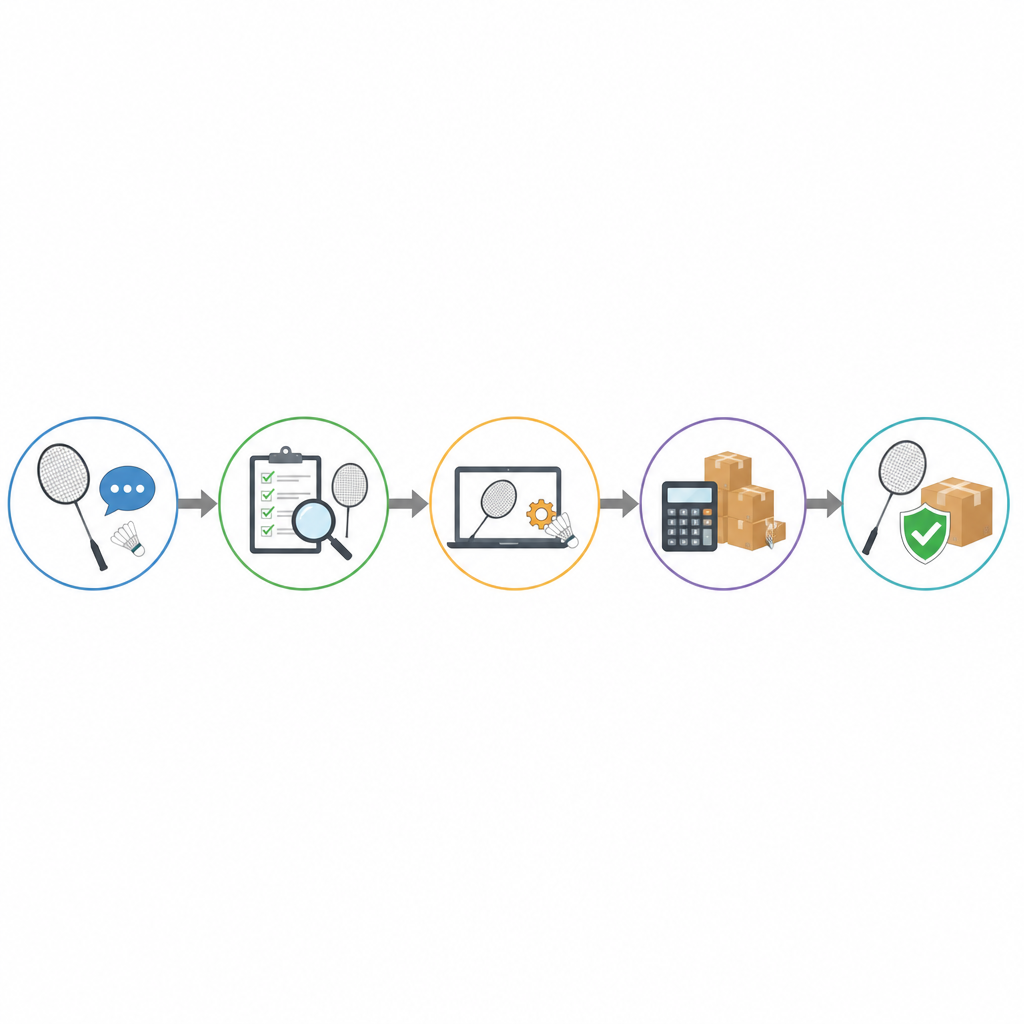
Step 1: Verify Manufacturing Capability Across Rackets, Shuttlecocks, and Accessories
Racket Production: Carbon Frame Layup and Stringing Lines
Choose a badminton racket supplier with in-house frame production if you need tight weight and balance control. Choose a coordinator model only if you are testing a small SKU set and can accept wider variation.
Carbon layup, curing, drilling, and stringing are separate bottlenecks. A line that handles all four steps can protect consistency, while a broker must wait on multiple outside vendors.
In rackets above 2,000 units, direct production usually gives better control over swing weight and grip finish. For smaller runs under 500 units, a trader can still work if you value flexibility more than margin.
Shuttlecock Production: Feather Sorting and Cork Assembly
A badminton shuttlecock supplier should show feather sorting rules, cork sourcing, and skirt assembly control. If the factory cannot explain those steps, batch flight stability will be hard to hold.
Feather length, curvature, and cork roundness interact during flight. Small defects in any one part can create wobble, slow recovery, or uneven speed grading.
Tournament buyers usually need tighter process control than recreational buyers. The best sign is not a glossy catalog; it is a measurable sorting and rejection system.
Accessories: Bags, Grips, and Apparel Bundling
Accessories are easiest to bundle, but they still need production proof. Bags, grips, and apparel should be tied to the same order plan so packaging and branding stay aligned.
Bundling works best when the factory already handles sewing, printing, or carton packing. If not, the supplier becomes a coordinator, and lead time expands with each extra handoff.
For a European retailer launching a private-label line, the practical test is whether one partner can support 2,000 rackets, 1,000 dozen shuttlecocks, and 500 bags per quarter. That volume needs stable scheduling, not just sample-stage enthusiasm.
Step 2: Audit OEM Customization Workflow Before You Sign the PO
The most common warning sign is a supplier that approves artwork too fast. A serious badminton OEM manufacturer documents revision rounds, confirms string tension targets, and locks grip color before mass production.
Custom work fails when each department works from a different file version. Revision control, sample approval, and sign-off discipline prevent logo drift, color mismatch, and stringing errors.
Our sampling workflow tracks 2.3 average revision rounds per OEM project (n=31 projects, 9 buyers) before artwork, grip color, and string tension are locked. That pattern is typical for private-label sports goods where the buyer wants brand consistency, not just a printed logo.
Most OEM mistakes come from version control, not from the factory floor.
If your badminton racket OEM customization MOQ is below 500 units, expect fewer decoration options and more setup fees. If you are above 2,000 units, ask for a formal sample timeline, revision cap, and artwork approval matrix.
That is where projects usually slip. A buyer who skips revision limits often discovers late-stage rework, and rework is expensive when packaging, printing, and stringing are already staged.
Step 3: Decode MOQ, Pricing Tiers, and the Hidden Cost Line Items
The cheapest quote is not always the best quote. A badminton equipment supplier can look inexpensive until tooling, packaging, inspection, and freight handling are added back in.
Lower MOQ usually raises per-unit setup cost, while higher MOQ lowers unit cost but ties up cash. The tradeoff is simple: choose low MOQ for market tests, and choose higher MOQ when sell-through is already proven.
Factory-direct pricing typically undercuts trading company quotes by 8–15% on racket OEM orders above 2,000 units (n=18 paired quotes across 6 product categories, 2024). But the real savings only appear when the order is large enough to absorb setup and inspection costs.
| Cost Item | Factory-Direct OEM | Trading Company |
|---|---|---|
| Base unit price | Lower on 2,000+ units | Usually 8–15% higher |
| MOQ flexibility | Lower flexibility | Higher flexibility |
| Customization depth | Full or near-full | Limited by outside factory |
| QC accountability | Direct | Shared or indirect |
| Best use case | Repeat programs | Small trials |
Choose factory-direct if your annual volume can absorb tooling and packaging setup.
Choose a trading company if you need a 300–500 unit pilot with limited branding.
Treat inspection, cartons, inserts, and freight as part of landed cost, not extras.
Step 4: Test Shuttlecock Consistency and Racket Frame Tolerance — The QC Checklist
Badminton shuttlecock quality control starts with cork geometry, feather symmetry, and flight repeatability. Racket QC starts with frame tolerance, weight spread, and string bed consistency.
Small geometry errors create big playability problems. A cork that is slightly off-round changes spin, while a frame that drifts outside tolerance changes balance and string feel.
In our QC program across 42 batches from 6 factories, feather shuttlecock rejection rates averaged 6.2% when cork roundness tolerance exceeded 0.3 mm. The same pattern appears in feather shuttlecock quality control when buyers inspect only feather grade and ignore the cork base.
A 0.3 mm cork tolerance miss can turn a good shuttlecock batch into a rejection batch.
Use ASTM material testing standards as a reference for structured test methods when you define acceptance criteria. For rackets, ask for weight tolerance, frame symmetry, and string tension checks before shipment.
If the supplier cannot show batch-level inspection records, the risk moves to your warehouse. Prevention is cheaper than sorting returns after arrival.
Trading Company vs Factory vs Hybrid OEM: Which Model Fits Your Sourcing Goal
Trading companies are better for low-volume tests, factories win on cost and control, and hybrid OEM models sit between the two. The right choice depends on how much customization and risk you can tolerate.
Trading companies reduce sourcing friction by bundling SKUs, but they add margin and reduce direct control. Factories lower unit cost and improve accountability, while hybrid OEM setups share lines across products and can cut setup waste.
The phrase badminton factory vs trading company sounds simple, but the real tradeoff is control versus convenience. For a buyer shipping 2,000 rackets and 1,000 dozen shuttlecocks per quarter, control usually matters more after the first pilot.
| Model | Best For | Main Limitation |
|---|---|---|
| Trading Company | Small trials, mixed SKUs | Higher margin, less control |
| Factory-Direct OEM | Repeat orders, deeper customization | Higher MOQ, stricter process |
| Hybrid OEM | Bundled programs, shared tooling | Moderate control, moderate complexity |
Trading Company: Low MOQ, Higher Margin, Limited Customization
Choose a trading company if you need a fast pilot under 500 units and do not need deep tooling changes. Choose it when your main goal is market testing, not long-term cost reduction.
The model works by buying coordination, not production control. That makes it useful for speed, but weak for fine-tuned branding or tight defect accountability.
This option usually fits first orders, seasonal tests, or broad product baskets. It is less suitable once your sell-through data justifies direct factory negotiation.
Factory-Direct OEM: Lower Cost, Full Customization, Higher MOQ
Choose factory-direct OEM when you need lower landed cost and stable repeat supply. Choose it if your annual volume can support the setup burden and you want direct access to production changes.
Factories spread tooling and line setup across larger runs, so unit cost falls as volume rises. The downside is stricter MOQ discipline and longer sampling cycles.
For private-label sports goods, this is usually the best route after a pilot proves demand. It gives the cleanest path to packaging control, product consistency, and margin protection.
Choose hybrid OEM if you want bundled SKUs without managing every sub-supplier yourself. Choose it when you need a middle ground between flexibility and control.
Hybrid setups work when one production base can share cartons, printing, or sewing across categories. The tradeoff is that complexity stays moderate, so timelines still need buffer.
For many mid-sized buyers, hybrid OEM is the best compromise after the first pilot order.
Step 5: Lock In Logistics, Lead Time, and After-Sales Responsibility
Choose a supplier with clear Incoterms, shipment milestones, and defect responsibility terms. Choose a slower partner only if the documentation is stronger and the compensation terms are clearer.
OEM badminton lead time logistics break down when sampling, production, inspection, and freight are treated as one stage. Each stage needs its own deadline, or the schedule slips without warning.
A European retailer sourcing 2,000 rackets and 1,000 dozen shuttlecocks reduced unit cost by 11% after switching from a trading company to a factory-direct badminton OEM manufacturer, with defect rates dropping from 7.4% to 2.1% (1 buyer, 2 production cycles, side-by-side PO comparison and defect log review). That is the kind of result you get when logistics and after-sales responsibility are written into the PO, not discussed later.
Red Flags and Common Mistakes When Vetting Badminton OEM Manufacturers
The biggest red flag is a supplier that avoids specific answers about line ownership, QC records, or revision history. Another warning is a quote that looks clean but excludes packaging, inspection, or rework.
These problems happen when a buyer treats the first sample as proof of mass production quality. Samples are often hand-finished, while bulk output depends on repeatable process control.
Verify every promise with a factory audit, a sample log, and a pre-shipment inspection plan. If the supplier resists any of those, you should expect surprises later.
Frequently Asked Questions
- What is a realistic MOQ when sourcing from a badminton equipment wholesale supplier?
- For rackets, 500–2,000 units per SKU is common. For feather shuttlecocks, 1,000–3,000 dozen is more realistic, while accessories can start around 300 units.
- How do I tell if a badminton racket supplier owns its factory?
- Ask for a factory audit, machinery list, export license, and a live video walk-through. A real factory can show production lines, not just a showroom.
- Do badminton OEM manufacturers need BWF approval?
- Only tournament-grade feather shuttlecocks sold under BWF-approved labeling need that path. Recreational OEM orders usually do not.
- What is the average lead time for an OEM badminton order?
- Sampling often takes 15–25 days, mass production 35–60 days, and pre-shipment inspection adds 7–10 days.
- How should I structure payment terms with a new supplier?
- A 30% deposit and 70% against bill of lading copy is common for first orders. Many buyers move to letter of credit after the third confirmed shipment.
The safest next step is to compare your target volume against the supplier model, then map that against sampling time, MOQ, and inspection cost. If you are still narrowing options, revisit the ISO and ASTM references, then build your own checklist before issuing the first PO for badminton equipment wholesale.