A practical B2B sourcing guide for baseball bat wholesale buyers. Compare aluminum alloy vs. carbon composite specs, evaluate OEM customization depth, navigate MOQs, and audit manufacturing QC before ordering.
Baseball Bat Wholesale & Custom OEM Sourcing Guide: Aluminum Alloy vs. Carbon Composite (2026)
For sports equipment importers, regional distributors, and private-label baseball brands, procuring baseball bats at wholesale involves navigating a complex matrix of metallurgical engineering, composite layup dynamics, league certification thresholds, and factory minimum order quantities (MOQs). While solid wood bats dominate professional play, amateur circuits, collegiate leagues, batting cages, and youth training academies depend almost exclusively on non-wood performance bats: specifically, aluminum alloy and carbon fiber composite constructions.
Sourcing directly from an established manufacturing partner rather than intermediary trading agencies yields a direct cost advantage of 15% to 22% on bulk orders exceeding 1,000 units. However, achieving sustainable retail margins requires commercial buyers to look past surface cosmetics and examine production tolerances: wall thickness consistency, barrel compression stiffness, end-cap bonding strength, and compliance with governing impact standards such as ASTM F2219.
Key Takeaways
- Material Distinction: Aircraft-grade 7050 aluminum alloy offers maximum durability, instant out-of-the-wrapper performance, and lower tooling entry barriers. Carbon fiber composite bats deliver expanded sweet spots, superior vibration dampening, and custom weight distribution, but require precision compression molding.
- Cost & MOQ Differential: Standard logo laser engraving on anodized alloy bats requires an initial batch of only 50–100 units. Dedicated composite tooling and proprietary multi-wall barrel molds typically require minimum commitments of 500 to 1,000 units.
- Factory Direct vs. Broker: Working directly with an ISO 9001-certified factory ensures traceability of raw billets and pre-preg carbon fabrics, eliminating sub-tier supplier markups and unvetted subcontracting.
- Quality Control Standards: Every commercial batch must be validated against compression displacement thresholds, end-cap tensile pull tests (>300 kgf), and dynamic barrel impact cycling at 80+ mph.
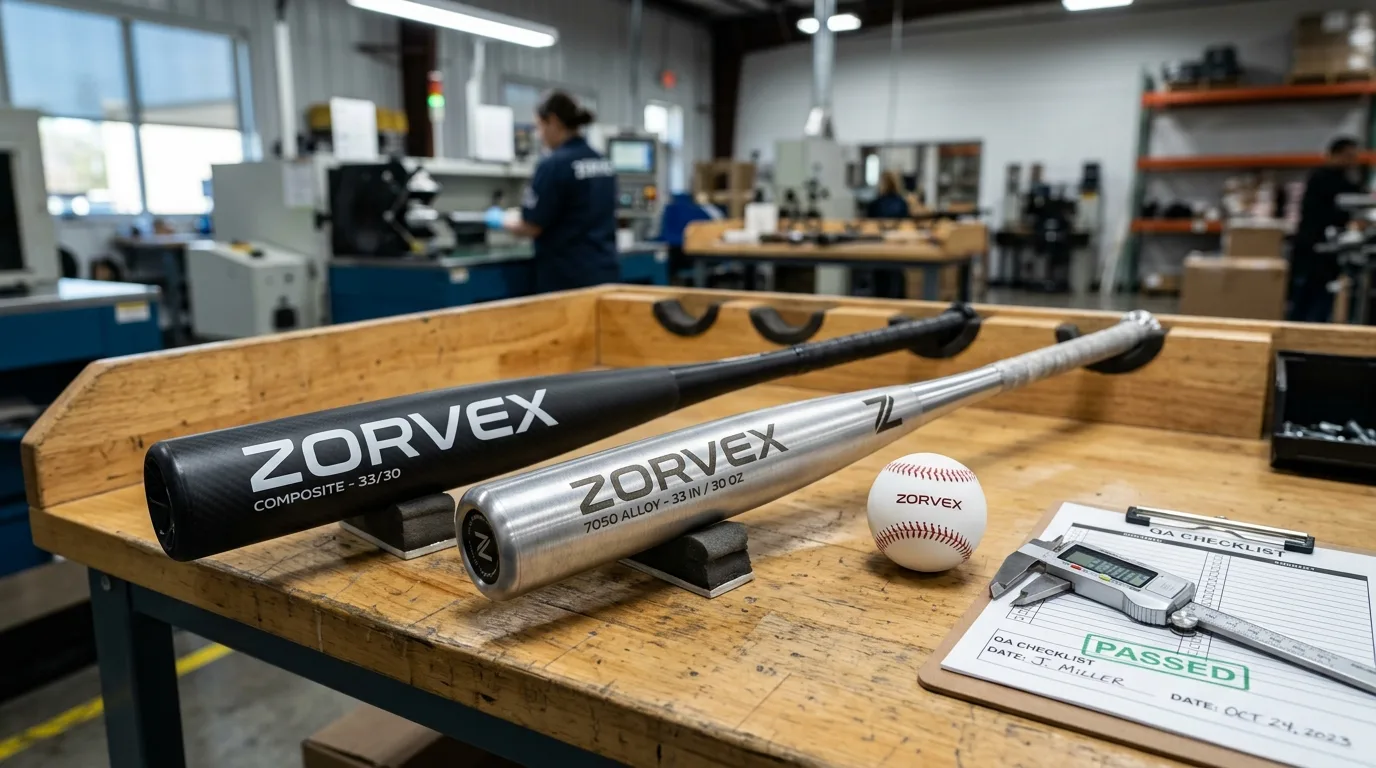
1. Material Comparison: Aluminum Alloy vs. Carbon Fiber Composite
Understanding the structural science separating alloy and composite bats is the foundation of accurate product positioning and catalog curation.
| Technical Parameter | Single-Wall Aluminum Alloy (6061-T6) | Multi-Wall / High-Grade Alloy (7050) | Multi-Layer Carbon Fiber Composite |
|---|---|---|---|
| Primary Use Case | Batting cages, recreational training, school programs | Competitive youth/adult leagues, high-frequency training | Tournament competition, high-performance travel teams |
| Sweet Spot Size | Standard (compact sweet zone) | Moderate (extended linear sweet zone) | Maximum (wide circular/elliptical sweet zone) |
| Trampoline Effect | Linear elastic response | High rebound coefficient | Optimized flex, tuned barrel rebound |
| Vibration Feedback | High sting on off-center hits | Moderate feedback (dampened knob) | Exceptional dampening (multi-axial carbon layup) |
| Durability Profile | Resistant to denting; immune to cracking | High fatigue resistance | Cannot dent; susceptible to composite shear if abused |
| Break-In Required | None (instant game-ready) | None (instant game-ready) | Requires 100–150 ball break-in cycle |
| Tooling Entry Barrier | Low (standard extruded tubing) | Medium (hydro-forming dies) | High (precision CNC steel compression molds) |
| Relative Production Cost | Baseline (1.0x) | 1.35x – 1.50x | 2.10x – 2.60x |
Aluminum Alloy: Durability and Rapid Turnaround
Commercial alloy bats utilize seamless extruded aluminum tubes. Entry-level models rely on 6061-T6 aluminum, renowned for corrosion resistance and reliable tensile strength. Premium competition bats utilize 7050 zinc-magnesium-copper alloy, which delivers a 28% higher yield strength over 6061. This allows factory engineers to thin the barrel walls without sacrificing structural integrity, generating higher trampoline rebound while preserving bat durability across cold-weather play.
Carbon Fiber Composite: Maximum Energy Transfer
Composite bats are engineered using multi-axial woven carbon fiber pre-preg fabrics wrapped around internal mandrels and cured under high pressure and heat. By tailoring the fiber orientation (0°, 45°, and 90° ply angles), engineers can isolate barrel hoop stiffness from handle flex. This mechanical decoupling produces the signature "whip" effect through the hitting zone, dramatically reducing handle feedback and sting when contact is made near the taper or end-cap.
2. Technical Specifications: Drop Weight, Barrel Diameter & Balance
When specifying an OEM production run, commercial buyers must define three fundamental dimensional variables:
1. Drop Weight (Length-to-Weight Ratio)
Drop weight represents the bat length in inches minus the total weight in ounces. Sourcing the wrong drop ratio can render an entire shipment non-compliant with targeted youth or adult federations:
- Drop -3 (BBCOR Standard): Mandatory for US high school and collegiate competition. E.g., a 33-inch bat must weigh exactly 30 ounces.
- Drop -5 and -8 (Senior League / Intermediate): Designed for transitional competitive youth players (ages 12–14).
- Drop -10 and -12 (Youth / USSSA / Tee Ball): Ultra-lightweight swing profiles engineered for young players developing swing mechanics.
2. Barrel Diameter Standards
- 2 1/4 inch (57.1 mm): Standard for traditional youth, Little League, and slow-pitch tee ball specifications.
- 2 5/8 inch (66.7 mm): BBCOR standard for high school and college adult play.
- 2 3/4 inch (69.8 mm): "Big Barrel" standard for competitive USSSA travel ball leagues, offering maximum contact surface area.
3. Moment of Inertia (MOI) & Weight Distribution
Two bats with the identical total mass of 30 ounces can swing entirely differently depending on their Moment of Inertia (MOI):
- Balanced Swing Weight: Mass is concentrated closer to the player's hands. Favored by contact hitters requiring rapid bat speed and plate coverage.
- End-Loaded Swing Weight: Additional mass is shifted toward the barrel end-cap. Favored by power hitters seeking maximum angular momentum and kinetic transfer upon contact.
A qualified factory controls MOI tolerances within ±2% by adjusting internal barrel wall taper thicknesses and end-cap counterweights.
3. OEM & ODM Customization Capabilities
Private-label sports brands and distributors require differentiated shelf presentation to command retail margins. Production customizations fall into three primary categories:
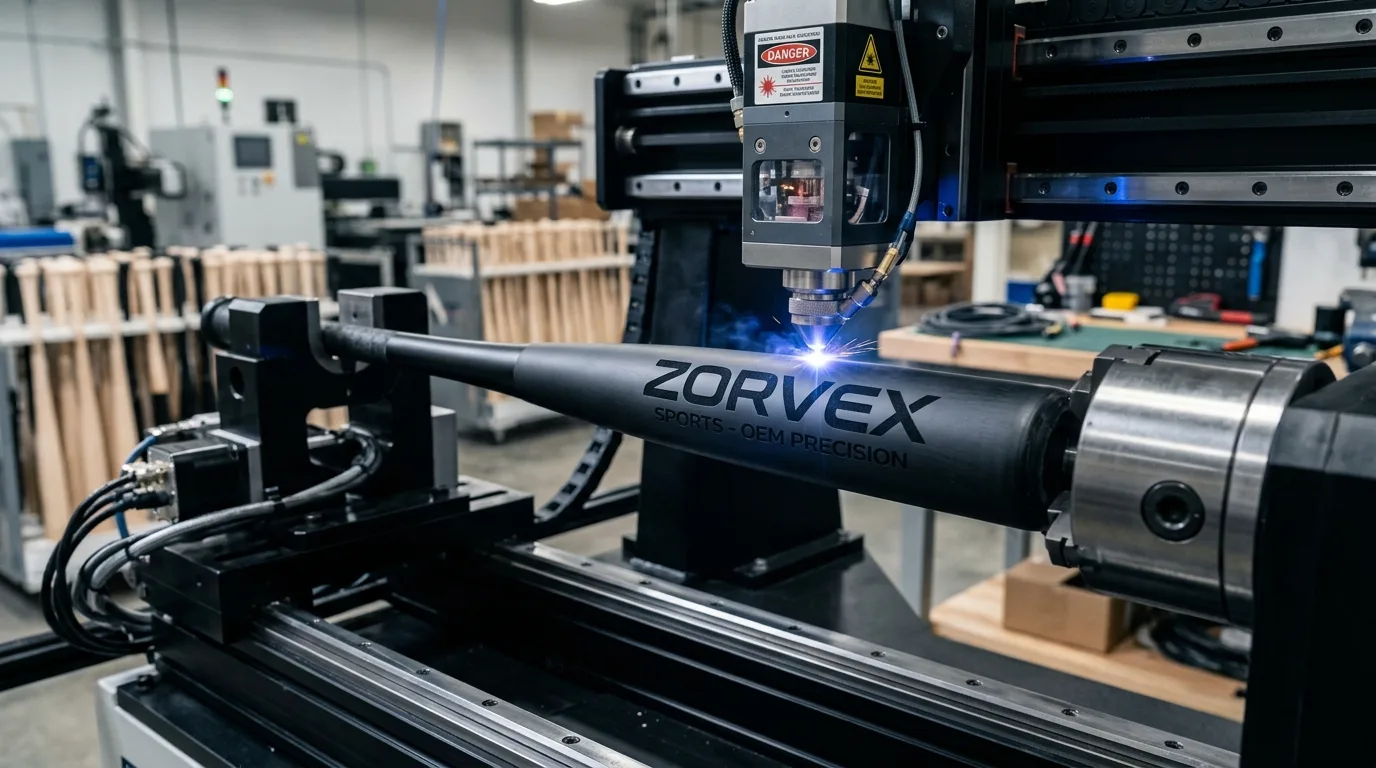
Precision Laser Etching & Surface Finishing
- Matte Black Baked Enamel: High-durability thermoset coating that resists chipping during batting cage impact and ball abrasion.
- Anodized Metallic Treatment: Electrochemical surface oxidation for aluminum bats, producing vibrant metallic tones (cobalt blue, titanium silver, ruby red) with permanent corrosion protection.
- Rotary CNC Laser Engraving: Direct surface ablation for team logos, serial numbers, and custom typography. Ideal for flexible initial order quantities (50–100 units) without tooling expenses.
- 3D Water-Transfer Decals: Full-barrel graphic wraps baked beneath an automotive-grade polyurethane clear coat, supporting intricate multi-color gradients and custom brand liveries.
Custom Handle & Grip Assembly
The handle interface directly impacts consumer perception. Standard OEM offerings include:
- Perforated PU Grip Tape: 1.1 mm or 1.8 mm synthetic polyurethane with moisture-wicking perforations and micro-ridged backing.
- Honeycomb Textured Cushioning: High-density EVA foam substrate wrapped in textured synthetic leather for advanced shock absorption.
- Tapered Knob Profiles: Ergonomic flared knobs, standard flat knobs, or integrated counterweighted end-plugs.
Retail & Wholesale Packaging Configurations
- Poly-Sleeve Bulk Pack: Cost-effective packaging for wholesale distributors and club accounts (25 units per master export carton).
- Individual Presentation Display Box: Four-color printed E-flute corrugated packaging with EVA form inserts for retail shelf display and e-commerce fulfillment.
4. Quality Control & Testing Protocols: How to Audit Your Supplier
Inconsistent wall thickness or improper resin curing leads directly to premature barrel denting, composite delamination, and brand liability. When vetting a Chinese manufacturing partner, require documented proof of the following in-house testing protocols:
Barrel Compression & Stiffness Verification
Using a calibrated pneumatic barrel compression fixture, static force is applied to measure barrel deflection. Consistent barrel deflection guarantees that every bat within a production lot performs within identical elastic boundaries, preventing hot-spot variations.
Dynamic Impact Cycling (ASTM F2219)
Under standard ASTM F2219 testing conditions, bats are subjected to repeated simulated impacts at speeds exceeding 80 mph (128 km/h). Premium composite bats must endure a minimum of 500 high-velocity impact cycles without internal ply cracking or audible delamination.
End-Cap Tensile Pull & Torsion Testing
End-caps must be mechanically anchored and chemically bonded using industrial structural acrylic or epoxy resins. The end-cap must withstand a direct mechanical tensile pull force of >300 kgf to prevent dangerous separation during competitive swings.
5. Commercial Sourcing Terms: MOQs, Lead Times & Landed Costs
| Order Tier | Typical Unit Volume | Scope of Customization | Estimated Lead Time | Unit Cost Advantage vs. Domestic Resellers |
|---|---|---|---|---|
| Tier 1: Sample & Validation | 2 – 5 units | Stock mold; laser-etched custom logo | 7 – 10 days | Benchmark sample cost |
| Tier 2: Brand Launch Pilot | 50 – 200 units | Custom surface colorway, laser branding, custom grip | 20 – 25 days | 12% – 16% savings |
| Tier 3: Commercial Wholesale | 500 – 1,000 units | Custom hydro-dip wrap, bespoke box packaging, tuned drop weights | 30 – 35 days | 18% – 25% savings |
| Tier 4: Enterprise OEM/ODM | 2,000+ units | Fully custom barrel tooling, proprietary carbon layup, certified ASTM testing | 35 – 45 days | 25% – 32% savings |
6. Sourcing Checklist for B2B Buyers
Before releasing a commercial deposit for custom baseball bats, verify that your supplier delivers complete documentation:
- Alloy Billet Traceability: Mill test certificates verifying 6061-T6 or 7050 alloy chemical composition.
- Weight Tolerance Guarantee: Guaranteed batch variance within $\pm 5$ grams across identical SKUs.
- Drop Weight Calibration: Verification that bat length and scale weight adhere strictly to target drop specifications.
- End-Cap Bonding Verification: 100% inspection logs for ultrasonic or epoxy joint bonding.
- Packaging Moisture Barrier: Heavy-duty master cartons lined with sealed PE moisture barrier bags to prevent handle mold during ocean transit.
- Factory Direct Verification: On-site or video audit confirming in-house extrusion shaping, CNC lathing, painting, and packing lines.
Partner with ZORVEX SPORTS for Your Baseball Bat Program
ZORVEX SPORTS operates advanced sports manufacturing facilities in Dongguan, China, specializing in high-performance aluminum alloy and carbon composite baseball bats, training baseballs, and athletic grip tape. Operating under certified ISO 9001:2015 quality management and supporting ASTM F2219 compliance testing, we provide global distributors, retail brands, and sporting academies with direct factory pricing, flexible MOQs, and comprehensive OEM/ODM engineering support.
- Direct Factory Inquiry: info@zorvex-sports.com
- WhatsApp / Phone: +86 13798920312
- Manufacturing Base: 10F, Tower A, Kaixuan International Building, Houjie Town, Dongguan City, Guangdong Province, China
- Product Range & Catalogs: Explore our Full Baseball Equipment Range or submit an OEM Project Inquiry.