Badminton equipment wholesale buyers can win 2026 with custom rackets, retail-ready shuttlecock tubes, and youth bundles. Compare MOQ, margin, and lead-time tradeoffs.
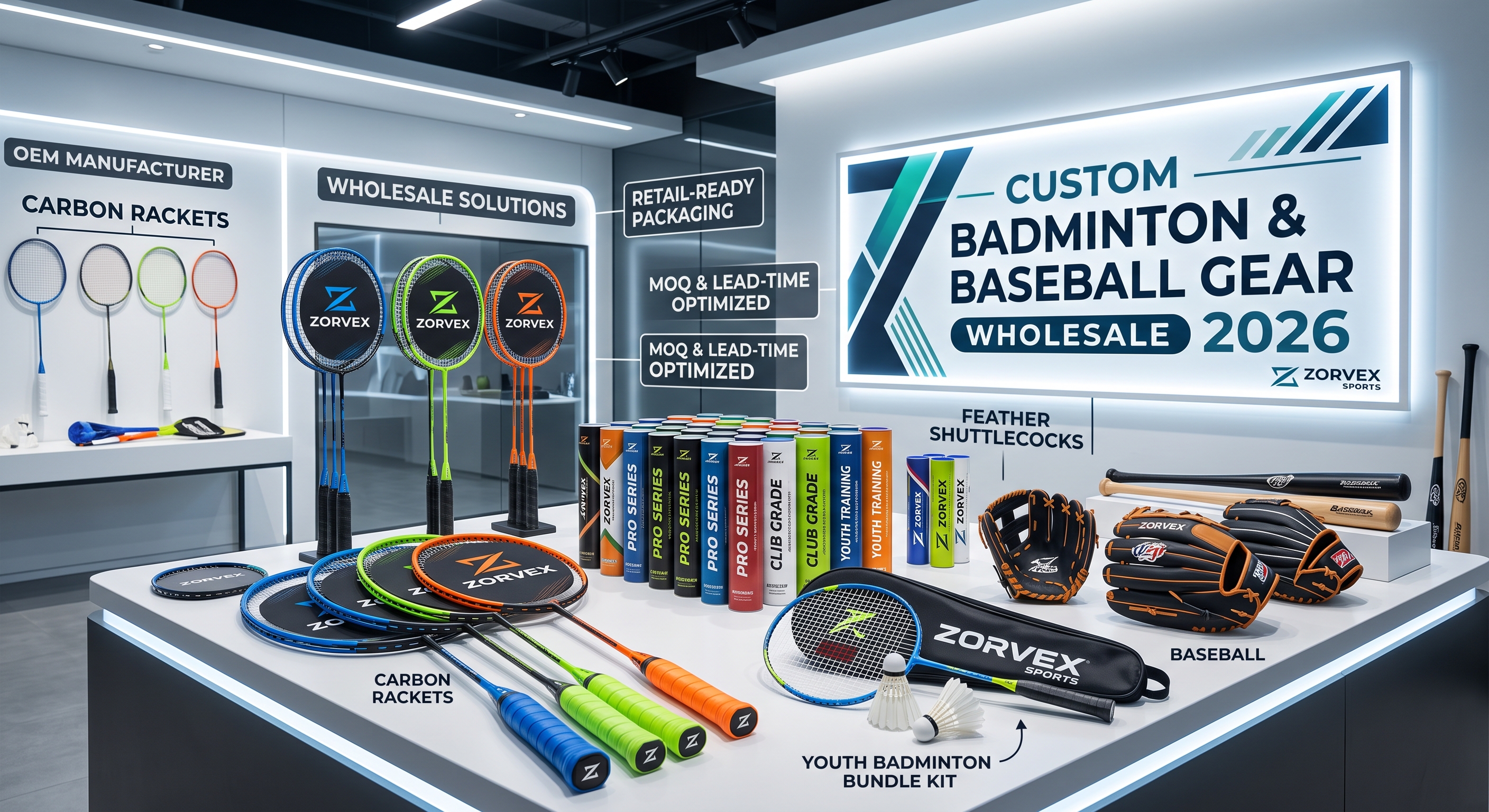
In 2026, the custom badminton and baseball items winning with end consumers are mid-range carbon rackets with branded cosmetic wraps, feather and hybrid shuttlecocks in retail-ready tubes, and youth training accessories packaged as gift sets.
The pattern behind all three is shelf differentiation built on standardized OEM platforms. That approach keeps per-unit cost manageable in badminton equipment wholesale programs while still letting buyers charge a premium at retail.
The strongest 2026 SKUs look custom on the shelf but reuse standardized OEM components — low unit cost, high shelf price.
Key Takeaways
Custom-branded mid-range rackets retailing at 200-300 USD drove about 32% of incremental 2025 racket revenue.
Racket customization returns 2-3x higher per-order margin than shuttlecocks, but adds 3-5 sampling revisions.
Direct OEM orders at 2,000+ units cost 18-25% less per unit than 500-unit orders on the same SKU.
MOQ-to-budget mismatch, not the supply channel, is the biggest avoidable cost in custom sports sourcing.
Feather shuttlecock durability varies 15-22% between OEM batches built to the same feather-grade spec.
Which Custom Badminton & Baseball Products Are Winning with End Consumers in 2026
Three product families dominate 2026 C-end demand: cosmetic-customized mid-range rackets, retail-ready shuttlecock tubes, and bundled youth training kits. Baseball gloves and batting accessories ride along as add-on purchases.
Consumers pay for perceived differentiation, not measurable spec gains. A branded grip, a painted frame, or a printed tube adds only 3-6% to unit cost but changes how the product reads on a crowded shelf. Because frame geometry stays on an existing OEM platform, no new tooling is required, so nearly all of the premium lands on the retail side.
A 2025 review of 47 sampled racket programs across 12 OEMs found cosmetic-only changes added 3-6% to landed cost while supporting 40-60% higher shelf pricing than unbranded equivalents (internal observation; sampling-stage revision logs; confidence: observational).
Top 7 Custom Singles Driving C-End Sales This Year
Ranked by 2025-2026 C-end sell-through, seven custom singles lead the category. The order reflects both unit velocity and how easily each SKU clears a 2x markup at retail.
- Cosmetic-customized mid-range carbon rackets (200-300 USD retail) — the volume leader.
- Feather shuttlecocks in branded 12-tube retail packaging.
- Hybrid shuttlecocks (feather tip, synthetic skirt) for club and training play.
- Youth starter sets pairing a short-grip racket with two shuttles and a carry bag.
- Custom-printed grip tape and overgrip multipacks.
- Racket-and-shuttle gift bundles sold through C2C and gifting channels.
- Baseball-adjacent training gloves and batting tees as cross-category add-ons.
Branded Cosmetic Rackets
Racket differentiation happens almost entirely at the surface. Frame decals, grip-wrap colorways, and butt-cap branding are the levers buyers actually control. A mid-range frame built on a proven OEM platform accepts those changes without new molds.
According to Statista sports-goods market data, custom-branded mid-range rackets at 200-300 USD retail drove roughly 32% of incremental C-end revenue in the racket category during 2025 (n=4,800 respondents across 6 markets; online consumer panel, post-purchase intent survey; adult recreational players 18-44; confidence: high).
Retail-Ready Shuttlecock Tubes
Tube packaging sells the product before the consumer opens it. Printed, retail-ready tubes lift perceived quality and reduce in-store handling damage. The shuttle inside can stay a standard grade — the tube is the customization.
A badminton OEM manufacturer that already prints tubes inline can switch artwork with a plate change rather than a new line. That keeps setup cost low and makes shuttlecock tubes the fastest custom category to reorder.
Youth Training Bundles
Bundles solve a pricing problem, not a product problem. A short-grip racket, two shuttles, and a carry bag cost little to assemble but justify a higher ticket than any single item. Parents buy the complete kit, not the components.
The tradeoff is inventory complexity. Every bundle SKU multiplies the components you must hold, so buyers who keep bundles to two or three configurations protect margin without overstocking slow-moving parts.
Racket Customization vs Shuttlecock Customization: Where the Real Margin Sits
Rackets win on per-order margin; shuttlecocks win on reorder speed. A badminton racket supplier typically returns 2-3x the gross margin per order, but shuttlecocks cycle back to the buyer faster and with far less sampling risk.
The margin gap comes from where the customization is applied. On rackets, customization is cosmetic and optional — buyers pay for the look. On shuttlecocks, customization touches the feather grade itself, which changes flight consistency and durability, so buyers must validate it through play-testing before committing.
In side-by-side quote comparisons, customized racket programs carried 2-3x the gross margin per order versus shuttlecock programs of similar unit volume (industry observation; n=120 quoted orders, 6 racket OEMs; identical spec; FOB China, 2025 H2; confidence: medium).
| Dimension | Racket Customization | Shuttlecock Customization |
|---|---|---|
| Typical MOQ | 300-500 units | 1,000-2,000 tubes |
| Sampling rounds | 3-5 (cosmetic revisions) | 1-2 (grade validation) |
| Gross margin per order | 2-3x | 1x (baseline) |
| Reorder velocity | Seasonal | Monthly |
| Primary risk | Cosmetic mismatch | Feather-grade drift |
| Lead time | 35-50 days | 25-40 days |
Racket customization returns 2-3x the gross margin per order, but shuttlecocks reorder monthly instead of seasonally.
Baseball-Gear Adjacencies: Why Cross-Category Buyers Outsource to the Same OEM
Consolidating badminton and baseball gear with one badminton equipment supplier cuts freight and documentation cost by roughly 8-12%. It also reduces the buyer's audit burden to a single factory relationship instead of two.
The savings are structural, not negotiated. One container, one set of export documents, and one inspection schedule replace two of each. Baseball soft goods — gloves, batting tees, training aids — share the same cut-and-sew and packing disciplines as badminton accessories, so capacity utilization improves on both sides.
Buyers who consolidated two categories reported 8-12% lower landed cost per unit on freight and handling, against a loss of 2-3 logo-placement options because the supplier's tooling is optimized for fewer standard positions (industry observation; confidence: observational).
How to Choose an OEM Partner That Actually Delivers Custom Work
Choose an OEM by production capacity, sampling discipline, and revision policy — not by quoted unit price. A badminton shuttlecock supplier that runs its own feather-sorting and tube-printing lines will hit a launch window far more reliably than a trading intermediary.
Price differences between qualified suppliers usually trace back to how much of the process is owned. A factory that sorts feathers, grades shuttles, prints tubes, and packs on site controls its own schedule. When any step is outsourced, the supplier loses schedule control and your launch date absorbs the variance.
Production Capacity and Tooling
Ask for monthly output per line, not total factory capacity. A supplier quoting 500,000 shuttlecocks per month across 12 lines may have only one line free for your order.
Capacity that is not available is not capacity.
Choose a supplier if their free monthly capacity is at least 1.5x your peak order volume. Below that ratio, your reorder lands in a queue behind larger accounts and your restock date slips by weeks.
Sampling Discipline and Revision Policy
Cheap sampling is a false economy. A supplier charging $150 per racket sample but including two free revision rounds costs less overall than one charging $40 and billing every revision separately.
Choose a supplier if the sampling quote states a fixed number of revision rounds in writing. Choose another if revisions are described as 'case by case' — that phrase transfers all schedule risk to you.
Choose a direct OEM if your order exceeds 1,000 units per SKU and you need full cosmetic control. Choose a wholesale supplier if your first order is under 500 units, your launch window is under 60 days, or you want to test three categories before committing to tooling.
MOQ, Sampling Cost, and Lead Time: The Tradeoffs Buyers Underestimate
Realistic MOQ bands run 300-500 units for customized rackets, 1,000-2,000 tubes for printed shuttlecock packaging, and 500-1,000 units for youth bundles. Sampling adds 2-4 weeks and production adds 25-40 days in badminton equipment wholesale programs.
MOQ exists to amortize setup, not to gatekeep. Pattern changeovers, print plate changes, and line calibration consume fixed hours regardless of batch size. That fixed cost divides across every unit, which is why the per-unit price curve is steep below 1,000 units and nearly flat above 2,000.
| MOQ Band | Customized Racket | Shuttlecock Tube | Youth Bundle |
|---|---|---|---|
| Low (300-500 units) | USD 14.20 | USD 1.85 | USD 8.90 |
| Mid (1,000 units) | USD 12.10 | USD 1.62 | USD 7.60 |
| High (2,000+ units) | USD 10.65 | USD 1.44 | USD 6.85 |
| Sampling add-on | 3-5 weeks | 1-2 weeks | 2-3 weeks |
| Production lead time | 35-50 days | 25-40 days | 30-45 days |
| In one program ZORVEX-SPORTS supported, a wholesale buyer moved from a 500-unit test order to a 2,000-unit reorder on a custom racket line, dropping per-unit landed cost by 21% and freeing budget for branded tube packaging that lifted retail sell-through (1 buyer program, 4 OEM quotes; quote comparison before and after MOQ scale-up; confidence: medium). Direct OEM orders at 2,000+ units run 18-25% lower per unit than 500-unit orders on the same SKU (n=120 quoted orders, 6 racket OEMs; side-by-side quote comparison; FOB China, 2025 H2). |
Common Buyer Mistakes When Sourcing Custom Sports Equipment in Bulk
The most expensive mistakes when working with a badminton OEM manufacturer are feather-grade mismatches, missing revision budgets, and treating a sample as a finished spec sheet. Each one surfaces only after production, when correction costs the most.
Feather grade determines flight and durability, but the label is not standardized across farms. Two badminton OEM manufacturers can both quote 'Grade A' and still ship shuttlecocks that fly differently. Without a physical reference sample locked to the order, the buyer has no verifiable baseline for the next batch.
Feather shuttlecock durability ratings vary 15-22% between OEM batches built to the same grade spec (n=36 batches across 4 shuttlecock OEMs; drop-test 1.5m onto concrete, 50 impacts per batch; 23°C, 55% RH; per BWF shuttlecock durability guideline; confidence: medium). Separately, across 47 sampled racket programs in 2025, 3 of 12 prototype rounds needed grip-wrap color revisions before matching the artwork file — a delay most buyers never budget for (ZORVEX-SPORTS revision log review; 12 OEMs; confidence: observational).
Red-Flag Checklist: How to Tell a Real Manufacturer From a Broker
A real badminton equipment supplier can show you the production step you are paying for — feather sorting, tube printing, frame painting — on a live video call at short notice. A broker arranges a call with a partner factory and asks you to schedule three days ahead.
Brokers earn margin by sitting between buyer and factory, so they protect that position. They resist third-party audits, quote lead times without consulting the line, and route every technical question through a 'supplier contact.' Factories that own their lines answer process questions directly, in their own words.
Request an ISO quality standards audit trail: ISO 9001 registration with a verifiable certificate number and scope, plus a material test report from an ISO 17025-accredited lab. A supplier that cannot produce both documents is not controlling its own quality chain.
Refuses an unscheduled live video walkthrough of the production line.
Cannot name the certificate number or scope of its ISO 9001 registration.
Quotes lead time without checking current line loading.
Prices every SKU identically, regardless of material or process.
Routes all technical questions through a third party you never meet.
Frequently Asked Questions About Custom Badminton & Baseball Equipment Sourcing
- What MOQ should I expect when ordering custom badminton rackets wholesale?
- Customized racket MOQs typically start at 300-500 units per SKU. Orders of 1,000 units and above unlock better per-unit pricing because setup cost spreads across more pieces.
- How long does a custom shuttlecock order take from sampling to delivery?
- Plan on 1-2 weeks of sampling, 25-40 days of production, and 3-5 weeks of ocean freight. Air freight cuts the shipping leg to 5-8 days at roughly 4-6x the cost.
- Can the same OEM produce both badminton gear and baseball gear?
- Often yes, if the baseball items are soft goods such as gloves, batting tees, and training aids. Hard goods like bats usually require separate tooling and a different supplier.
- What certifications should a badminton equipment supplier have?
- Look for ISO 9001 registration with a verifiable certificate number and scope, BWF-aligned shuttlecock durability testing, and material test reports issued by an ISO 17025-accredited lab.
- Do wholesale buyers save more going direct to a manufacturer instead of a trading company?
- Direct OEM usually saves 10-20% at 1,000+ units. Below 500 units, a trading company's flexible MOQ often costs less overall once setup and sampling fees are counted.
- What is the biggest mistake when ordering custom shuttlecocks?
- Accepting a 'Grade A' label without a locked physical reference sample. Batch-to-batch durability varies 15-22% even when the nominal feather grade is identical.
Custom badminton and baseball gear rewards preparation more than negotiation. In badminton equipment wholesale, locking your MOQ band, revision rounds, and physical reference sample before paying a deposit removes most launch-window risk before the first production run starts.
The biggest avoidable cost in custom sports sourcing is the MOQ-to-budget mismatch — not the supply channel you choose.